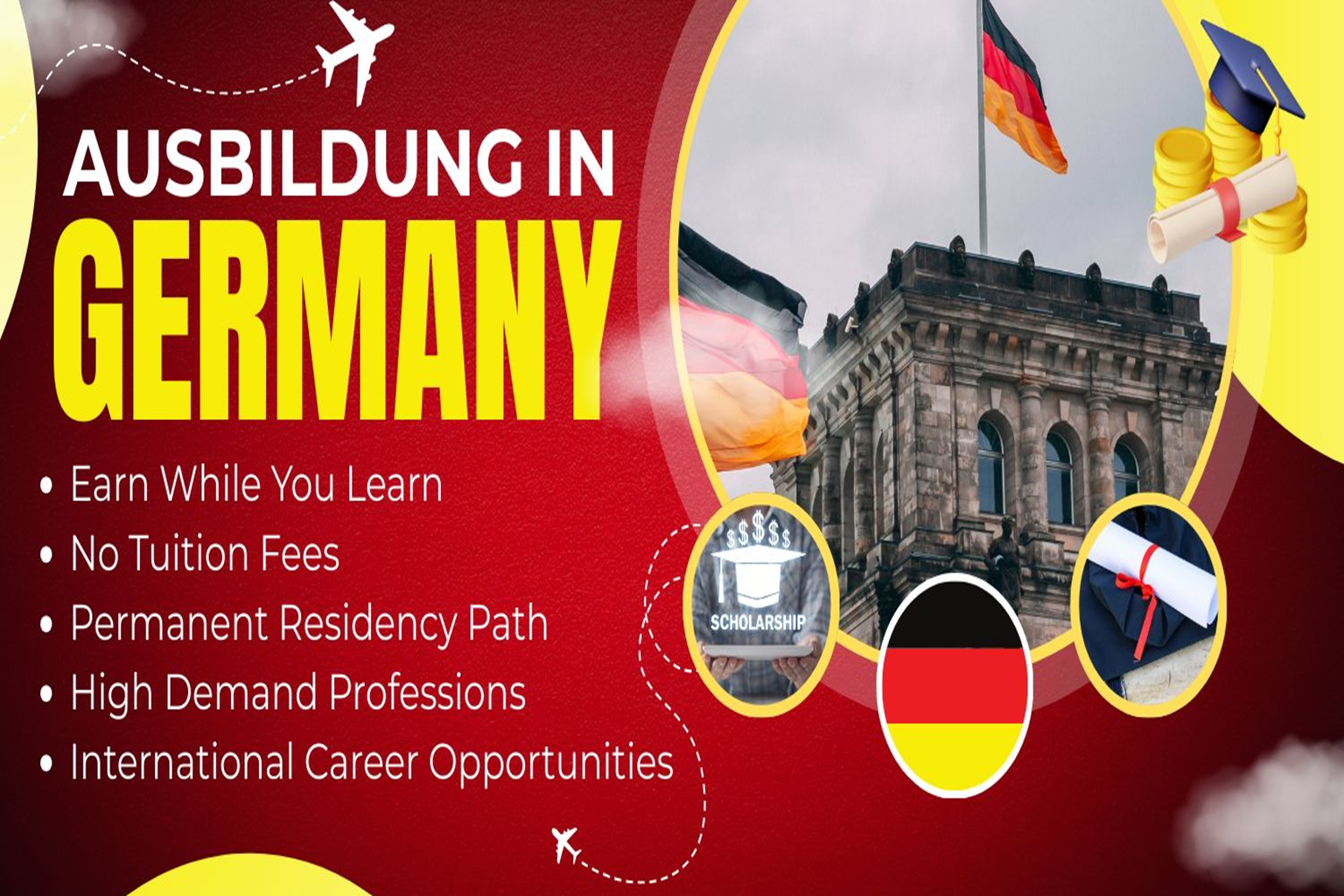
Here’s a full, up-to-date overview of Ausbildung (vocational training) programs in Germany for international students for the 2026–2027 period — including what Ausbildung is, key features, popular fields, entry requirements, how they work, and trends. This summary helps you understand all the options available, how the system operates, and which programs are most relevant for international applicants.
Table of Contents
Toggle🇩🇪 What Is Ausbildung and How It Works
Ausbildung is Germany’s dual vocational training system, combining practical training in a company with theoretical education at a vocational school (Berufsschule). You earn a training contract with an employer and receive a monthly stipend while you learn — typically lasting 2 to 3.5 years.
Key aspects
- Dual structure: workplace + school
- State-recognized qualification at the end
- Monthly pay increases over the years
- Start usually in August/September (some exceptions)
- Over 300+ recognized apprenticeship professions available across sectors
International accessibility
- Non-EU applicants must secure a training contract and Ausbildung visa before arrival.
- Many employers recruit international trainees, especially in high-demand sectors.
📌 Entry Requirements for International Students
📍 Education
- Secondary school completion (e.g., 10th/12th grade or equivalent) is generally required.
- Credentials must be recognized in Germany (often through ZAB or anabin).
📍 German Language
- German proficiency is essential because the training and vocational classes are in German.
- Most companies and schools expect B1 minimum, many require B2 especially for healthcare.
- For highly language-intensive fields like nursing, B2 is strongly recommended.
📍 Contract First, Visa Later
- You must secure an Ausbildungsvertrag (training contract) with a German employer before applying for your national training visa.
🎓 How Ausbildung Programs Are Structured
📌 Dual Apprenticeship
- Practical work at a company (workplace training)
- Theoretical lessons at vocational school
- Duration: 2–3.5 years
- Paid monthly training allowance
- Ends with state exam and qualification
📌 School-Based Training
- Teaching mainly at vocational schools with practical internship phases
- Duration varies (often 1–3 years)
- Sometimes no stipend; may have small fees
- Requires separate application to school
📌 Language Support & Digital Tools
- Many programs now integrate digital skills training and employer-supported German learning.
- Some companies offer language classes as part of onboarding.
📊 Popular Ausbildung Courses & Fields (2026–2027)
Here’s a wide selection of training routes suitable for international students, ranging from traditional trades to modern technical careers:
🩺 Healthcare & Social Services
- Pflegefachmann/-frau (Nursing Specialist)
- Medizinische/r Fachangestellte/r (Medical Assistant)
- Zahnmedizinische/r Fachangestellte/r (Dental Assistant)
💡 High demand due to ageing population and staff shortages.
💻 IT & Digital Technology
- Fachinformatiker/in (IT Specialist — Systems, Software, Networking)
- IT Infrastructure / Network Apprenticeships
💡 Some positions may offer English-friendly components, but German is still key.
🔧 Engineering & Technical Trades
- Mechatroniker/in (Mechatronics Technician)
- Elektroniker/in (Electronics Technician)
- Kfz-Mechatroniker/in (Automotive Tech)
- Industriemechaniker/in (Industrial Mechanic)
💡 Core demand in manufacturing and industrial sectors.
🧑💼 Business & Administration
- Industriekaufmann/-frau (Industrial Clerk)
- Kaufmann/-frau für Büromanagement (Office Administrator)
- Kaufmann/-frau im Einzelhandel (Retail Sales)
💡 Large number of training spots across Germany.
🚚 Logistics & Supply Chain
- Kaufmann/-frau für Spedition und Logistikdienstleistung (Logistics Specialist)
💡 E-commerce and global trade growth fuels demand.
🍽️ Hospitality & Tourism
- Hotelfachmann/-frau (Hotel Specialist)
- Fachkraft für Gastronomie (Restaurant Professional)
💡 Good for international environments and Jobs with social skills focus.
🛠️ Others (Crafts & Specialized)
- Tischler/in (Carpenter/Wood Mechanic)
- Chemielaborant/in (Chemical Lab Assistant)
- Biologisch-technische/r Assistent/in (Biotech Assistant)
💡 Examples from broader training lists.
💶 Earning & Career Outcomes
📍 Monthly Earnings During Training
Trainees typically receive a training allowance, increasing each year (e.g., ~€900–€1,400 depending on profession and year).
📍 After Graduation
Qualified apprentices often find full-time employment, and many can extend their residence permit to find a job related to their Ausbildung.
📆 2026–2027 Application Timeline (Typical)
| Stage | Timeline (2026–2027) |
|---|---|
| Start researching programs | Now → Mid-2026 |
| Learn German | Ongoing; aim B1/B2 before end of 2026 |
| Apply for training Jobs | Sep–Dec 2026 (for 2027 starts) |
| Secure contract | Late 2026 – Early 2027 |
| Visa application | After contract secured |
| Training begins | Aug/Sep 2027 (typical) |
| Note: Some sectors may have different start dates — always verify with employers. |
📌 Tips for International Applicants
✅ Begin German language learning early (B1 minimum; B2 recommended for client/healthcare roles).
✅ Apply broadly (10–20+ companies) — competition can be high, especially for international applicants.
✅ Use official portals like Make-it-in-Germany/Bundesagentur für Arbeit for job search and guidance.
✅ Prepare German-style CV and motivation letter.
🧠 Summary
Germany’s Ausbildung system offers practical, paid, career-oriented vocational training across hundreds of professions — and it’s open to international students who secure a training contract and meet language & educational requirements. Popular fields with strong demand in 2026–2027 include healthcare, IT, Engineering, business, logistics, hospitality, and diverse craft trades.